class: center, middle, inverse, title-slide # Deep Learning in R ## ░ <br/>Обзор фреймворков с примерами ### metya ### 2018-12-08 --- class: center, middle background-color: #8d6e63 #Disclaimer Цель доклада не дать понимаение что такое глубокое обучение и детально разобрать как работать с ним и обучать современные модели, а скорее показать как просто можно начать тем, кто давно хотел и чесались руки, но все было никак не взяться --- # Deep Learning ## Что это? -- * Когда у нас есть исскуственная нейронная сеть -- * Когда скрытых слоев в этой сети больше чем два -- 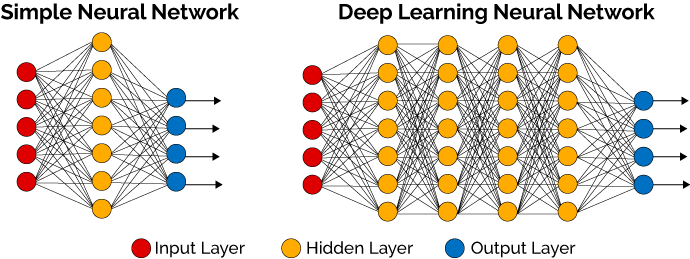 .footnotes[[1] https://machinelearningmastery.com/what-is-deep-learning/] --- ## Как это математически  ??? На самом деле это конечно самый простой юнит, самый базовый. --- background-image: url(https://3qeqpr26caki16dnhd19sv6by6v-wpengine.netdna-ssl.com/wp-content/uploads/2016/08/Why-Deep-Learning-1024x742.png) ??? Image credit: [Andrew Ng](http://www.slideshare.net/ExtractConf) --- class: inverse, center, middle, title-slide # Frameworks --- 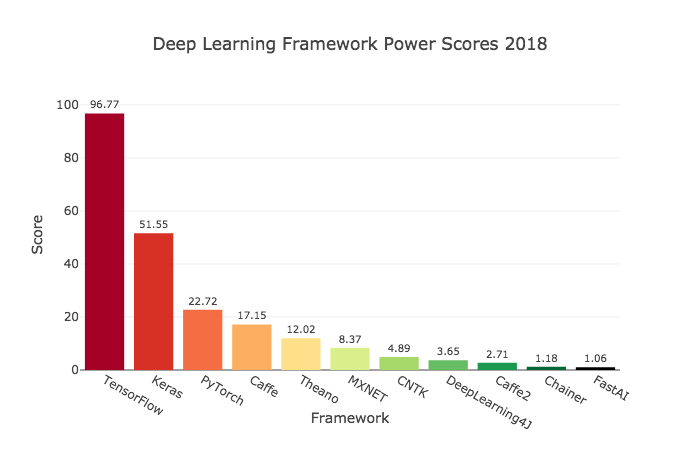 .footnotes[ [1] https://towardsdatascience.com/deep-learning-framework-power-scores-2018-23607ddf297a ] --- ## Нас интересуют только те, что есть в R через API -- * ###TensorFlow -- * ###theano -- * ###Keras -- * ###CNTK -- * ###MXNet -- * ###ONNX --- ## Есть еше несколько пакетов * darch (removed from cran) * deepnet * deepr * H2O (interface) ([Tutorial](https://htmlpreview.github.io/?https://github.com/ledell/sldm4-h2o/blob/master/sldm4-deeplearning-h2o.html)) ??? Вода это по большей части МЛ фреймворк, с недавних пор, где появился модуль про глубокое обучение. Есть неплохой туториал для р пакета. Умеет в поиск гиперпараметров, кроссвалидацию и прочие нужные для МЛ штуки для сеток, очевидно это работает только для маленьких сетей) Но они р специфичны, кроме воды, и соотвественно медленные, да и умеют довольно мало. Новые годные архитектуры сетей туда не имплементированы. ---  https://www.tensorflow.org/ https://tensorflow.rstudio.com/ - Делает Google - Самый популярный, имеет тучу туториалов и книг - Имеет самый большой спрос у продакшн систем - Имеет API во множестве языков - Имеет статический граф вычислений, что бывает неудобно, зато оптимизированно - Примерно с лета имеет фичу **eager execution**, который почти нивелирует это неудобство. Но почти не считается - Доступен в R как самостоятельно, так и как бэкэнд Keras ---  http://www.deeplearning.net/software/theano/ - Делался силами университета Монреаль с 2007 - Один из самый старых фреймворков, но почти почил в забытьи - Придумали идею абстракции вычислительных графов (статических) для оптимизации и вычисления нейронных сетей - В R доступен как бэкенд через Keras ---  https://cntk.ai/ - Делается силами Майкрософт - Имеет половинчатые динамические вычислительные графы (на самом деле динамические тензоры скорее) - Доступен как бэкенд Keras так и как самостоятельный бэкенд с биндингами в R через reticulate package, что значит нужно иметь python версию фреймворка ---  https://keras.io/ https://keras.rstudio.com/ https://tensorflow.rstudio.com/keras/ - Высокоуровневый фреймворк над другими такими бэкэндами как Theano, CNTK, Tensorflow, и еще некоторые на подходе - Делается Франсуа Шолле, который написал книгу Deep Learning in R - Очень простой код - Один и тот же код рабоает на разных бэкендах, что теоретически может быть полезно (нет) - Есть очень много блоков нейросетей из современных SOTA работ - Нивелирует боль статических вычислительных графов - Уже давно дефолтом поставляется вместе с TensorFlow как его часть, но можно использовать и отдельно --- <img src="https://raw.githubusercontent.com/dmlc/dmlc.github.io/master/img/logo-m/mxnetR.png" style=width:30% /> https://mxnet.apache.org/ https://github.com/apache/incubator-mxnet/tree/master/R-package - Является проектом Apache - Сочетает в себе динамические и статические графы - Тоже имеет зоопарк предобученных моделей - Как и TensorFlow поддерживается многими языками, что может быть очень полезно - Довольно разумный и хороший фреймворк, непонятно, почему не пользуется популярностью ---  https://onnx.ai/ https://onnx.ai/onnx-r/ - Предоставляет открытый формат представления вычислительных графов, чтобы можно было обмениваться запускать одни и теже, экспортированные в этот формат, модели с помощью разных фреймворков и своего рантайма - Можно работать из R - Изначально делался Microsoft вместе с Facebook - Поддерживает кучу фреймворков нативно и конвертацию в ML и TF, Keras --- class: inverse, middle, center # Deep Learning with MXNet --- ## Установка В Windows и MacOS в R ```r # Windows and MacOs cran <- getOption("repos") cran["dmlc"] <- "https://apache-mxnet.s3-accelerate.dualstack.amazonaws.com/R/CRAN/GPU/cu92" options(repos = cran) install.packages("mxnet") ``` Linux bash ```bash # On linux git clone --recursive https://github.com/apache/incubator-mxnet.git mxnet cd mxnet/docs/install ./install_mxnet_ubuntu_python.sh ./install_mxnet_ubuntu_r.sh cd incubator-mxnet make rpkg ``` --- ## Загрузка и обработка данных ```r df <- read_csv("data.csv") set.seed(100) ``` ```r #transform and split train on x and y train_ind <- sample(1:77, 60) x_train <- as.matrix(df[train_ind, 2:8]) y_train <- unlist(df[train_ind, 9]) x_val <- as.matrix(df[-train_ind, 2:8]) y_val <- unlist(df[-train_ind, 9]) ``` --- ## Задания архитектуры сети ```r require(mxnet) # define graph data <- mx.symbol.Variable("data") fc1 <- mx.symbol.FullyConnected(data, num_hidden = 1) linreg <- mx.symbol.LinearRegressionOutput(fc1) # define learing parameters initializer <- mx.init.normal(sd = 0.1) optimizer <- mx.opt.create("sgd", learning.rate = 1e-6, momentum = 0.9) # define logger logger <- mx.metric.logger() epoch.end.callback <- mx.callback.log.train.metric( period = 4, # число батчей, после которого оценивается метрика logger = logger) # num of epoch n_epoch <- 20 ``` --- ## Построим граф модели ```r # plot our model graph.viz(linreg) ``` <img src="Deep_Learning_in_R_files/graph.png" style="width:50%" > --- ## Обучим ```r model <- mx.model.FeedForward.create( symbol = linreg, # our model X = x_train, # our data y = y_train, # our label ctx = mx.cpu(), # engine num.round = n_epoch, initializer = initializer, # inizialize weigths optimizer = optimizer, # sgd optimizer eval.data = list(data = x_val, label = y_val), # evaluation on evey epoch eval.metric = mx.metric.rmse, # metric array.batch.size = 15, epoch.end.callback = epoch.end.callback) # logger ``` ``` ## Warning in mx.model.select.layout.train(X, y): Auto detect layout of input matrix, use rowmajor.. ``` ``` ## Start training with 1 devices ``` ``` ## [1] Train-rmse=7.85010987520218 ``` ``` ## [1] Validation-rmse=7.99821019172668 ``` ``` ## [2] Train-rmse=9.21365368366241 ``` ``` ## [2] Validation-rmse=4.74030923843384 ``` ``` ## [3] Train-rmse=4.16309010982513 ``` ``` ## [3] Validation-rmse=7.18643116950989 ``` ``` ## [4] Train-rmse=5.20915931463242 ``` ``` ## [4] Validation-rmse=3.87698078155518 ``` ``` ## [5] Train-rmse=4.94802039861679 ``` ``` ## [5] Validation-rmse=3.80227029323578 ``` ``` ## [6] Train-rmse=2.69853216409683 ``` ``` ## [6] Validation-rmse=3.90478467941284 ``` ``` ## [7] Train-rmse=3.52689051628113 ``` ``` ## [7] Validation-rmse=2.31562197208405 ``` ``` ## [8] Train-rmse=2.99551945924759 ``` ``` ## [8] Validation-rmse=2.93496096134186 ``` ``` ## [9] Train-rmse=2.22769635915756 ``` ``` ## [9] Validation-rmse=2.37067186832428 ``` ``` ## [10] Train-rmse=2.5699103474617 ``` ``` ## [10] Validation-rmse=1.86853647232056 ``` ``` ## [11] Train-rmse=2.24543181061745 ``` ``` ## [11] Validation-rmse=2.3385466337204 ``` ``` ## [12] Train-rmse=2.03947871923447 ``` ``` ## [12] Validation-rmse=1.82985359430313 ``` ``` ## [13] Train-rmse=2.111790984869 ``` ``` ## [13] Validation-rmse=1.74209445714951 ``` ``` ## [14] Train-rmse=1.98190069198608 ``` ``` ## [14] Validation-rmse=1.98799872398376 ``` ``` ## [15] Train-rmse=1.9320664703846 ``` ``` ## [15] Validation-rmse=1.68956047296524 ``` ``` ## [16] Train-rmse=1.91881200671196 ``` ``` ## [16] Validation-rmse=1.68268179893494 ``` ``` ## [17] Train-rmse=1.87585905194283 ``` ``` ## [17] Validation-rmse=1.79575181007385 ``` ``` ## [18] Train-rmse=1.85955160856247 ``` ``` ## [18] Validation-rmse=1.64644628763199 ``` ``` ## [19] Train-rmse=1.83187100291252 ``` ``` ## [19] Validation-rmse=1.63903748989105 ``` ``` ## [20] Train-rmse=1.81522011756897 ``` ``` ## [20] Validation-rmse=1.68724113702774 ``` --- ## Построим кривую обучения ```r rmse_log <- data.frame(RMSE = c(logger$train, logger$eval),dataset = c(rep("train", length(logger$train)), rep("val", length(logger$eval))),epoch = 1:n_epoch) library(ggplot2) ggplot(rmse_log, aes(epoch, RMSE, group = dataset, colour = dataset)) + geom_point() + geom_line() ``` <!-- --> --- class: inverse, center, middle # Deep Learning with Keras --- ## Установка ```r install.packages("keras") keras::install_keras(tensorflow = 'gpu') ``` ### Загрузка нужных нам пакетов ```r require(keras) # Neural Networks require(tidyverse) # Data cleaning / Visualization require(knitr) # Table printing require(rmarkdown) # Misc. output utilities require(ggridges) # Visualization ``` --- ## Загрузка данных ```r activityLabels <- read.table("Deep_Learning_in_R_files/HAPT Data Set/activity_labels.txt", col.names = c("number", "label")) activityLabels %>% kable(align = c("c", "l")) ``` number label -------- ------------------- 1 WALKING 2 WALKING_UPSTAIRS 3 WALKING_DOWNSTAIRS 4 SITTING 5 STANDING 6 LAYING 7 STAND_TO_SIT 8 SIT_TO_STAND 9 SIT_TO_LIE 10 LIE_TO_SIT 11 STAND_TO_LIE 12 LIE_TO_STAND --- ```r labels <- read.table("Deep_Learning_in_R_files/HAPT Data Set/RawData/labels.txt", col.names = c("experiment", "userId", "activity", "startPos", "endPos")) dataFiles <- list.files("Deep_Learning_in_R_files/HAPT Data Set/RawData") labels %>% head(50) %>% paged_table() ``` <div data-pagedtable="false"> <script data-pagedtable-source type="application/json"> {"columns":[{"label":[""],"name":["_rn_"],"type":[""],"align":["left"]},{"label":["experiment"],"name":[1],"type":["int"],"align":["right"]},{"label":["userId"],"name":[2],"type":["int"],"align":["right"]},{"label":["activity"],"name":[3],"type":["int"],"align":["right"]},{"label":["startPos"],"name":[4],"type":["int"],"align":["right"]},{"label":["endPos"],"name":[5],"type":["int"],"align":["right"]}],"data":[{"1":"1","2":"1","3":"5","4":"250","5":"1232","_rn_":"1"},{"1":"1","2":"1","3":"7","4":"1233","5":"1392","_rn_":"2"},{"1":"1","2":"1","3":"4","4":"1393","5":"2194","_rn_":"3"},{"1":"1","2":"1","3":"8","4":"2195","5":"2359","_rn_":"4"},{"1":"1","2":"1","3":"5","4":"2360","5":"3374","_rn_":"5"},{"1":"1","2":"1","3":"11","4":"3375","5":"3662","_rn_":"6"},{"1":"1","2":"1","3":"6","4":"3663","5":"4538","_rn_":"7"},{"1":"1","2":"1","3":"10","4":"4539","5":"4735","_rn_":"8"},{"1":"1","2":"1","3":"4","4":"4736","5":"5667","_rn_":"9"},{"1":"1","2":"1","3":"9","4":"5668","5":"5859","_rn_":"10"},{"1":"1","2":"1","3":"6","4":"5860","5":"6786","_rn_":"11"},{"1":"1","2":"1","3":"12","4":"6787","5":"6977","_rn_":"12"},{"1":"1","2":"1","3":"1","4":"7496","5":"8078","_rn_":"13"},{"1":"1","2":"1","3":"1","4":"8356","5":"9250","_rn_":"14"},{"1":"1","2":"1","3":"1","4":"9657","5":"10567","_rn_":"15"},{"1":"1","2":"1","3":"1","4":"10750","5":"11714","_rn_":"16"},{"1":"1","2":"1","3":"3","4":"13191","5":"13846","_rn_":"17"},{"1":"1","2":"1","3":"2","4":"14069","5":"14699","_rn_":"18"},{"1":"1","2":"1","3":"3","4":"14869","5":"15492","_rn_":"19"},{"1":"1","2":"1","3":"2","4":"15712","5":"16377","_rn_":"20"},{"1":"1","2":"1","3":"3","4":"16530","5":"17153","_rn_":"21"},{"1":"1","2":"1","3":"2","4":"17298","5":"17970","_rn_":"22"},{"1":"2","2":"1","3":"5","4":"251","5":"1226","_rn_":"23"},{"1":"2","2":"1","3":"7","4":"1227","5":"1432","_rn_":"24"},{"1":"2","2":"1","3":"4","4":"1433","5":"2221","_rn_":"25"},{"1":"2","2":"1","3":"8","4":"2222","5":"2377","_rn_":"26"},{"1":"2","2":"1","3":"5","4":"2378","5":"3304","_rn_":"27"},{"1":"2","2":"1","3":"11","4":"3305","5":"3572","_rn_":"28"},{"1":"2","2":"1","3":"6","4":"3573","5":"4435","_rn_":"29"},{"1":"2","2":"1","3":"10","4":"4436","5":"4619","_rn_":"30"},{"1":"2","2":"1","3":"4","4":"4620","5":"5452","_rn_":"31"},{"1":"2","2":"1","3":"9","4":"5453","5":"5689","_rn_":"32"},{"1":"2","2":"1","3":"6","4":"5690","5":"6467","_rn_":"33"},{"1":"2","2":"1","3":"12","4":"6468","5":"6709","_rn_":"34"},{"1":"2","2":"1","3":"1","4":"7624","5":"8252","_rn_":"35"},{"1":"2","2":"1","3":"1","4":"8618","5":"9576","_rn_":"36"},{"1":"2","2":"1","3":"1","4":"9991","5":"10927","_rn_":"37"},{"1":"2","2":"1","3":"1","4":"11311","5":"12282","_rn_":"38"},{"1":"2","2":"1","3":"3","4":"13129","5":"13379","_rn_":"39"},{"1":"2","2":"1","3":"3","4":"13495","5":"13927","_rn_":"40"},{"1":"2","2":"1","3":"2","4":"14128","5":"14783","_rn_":"41"},{"1":"2","2":"1","3":"3","4":"15037","5":"15684","_rn_":"42"},{"1":"2","2":"1","3":"2","4":"15920","5":"16598","_rn_":"43"},{"1":"2","2":"1","3":"3","4":"16847","5":"17471","_rn_":"44"},{"1":"2","2":"1","3":"2","4":"17725","5":"18425","_rn_":"45"},{"1":"3","2":"2","3":"5","4":"298","5":"1398","_rn_":"46"},{"1":"3","2":"2","3":"7","4":"1399","5":"1555","_rn_":"47"},{"1":"3","2":"2","3":"4","4":"1686","5":"2627","_rn_":"48"},{"1":"3","2":"2","3":"8","4":"2628","5":"2769","_rn_":"49"},{"1":"3","2":"2","3":"5","4":"2770","5":"3904","_rn_":"50"}],"options":{"columns":{"min":{},"max":[10]},"rows":{"min":[10],"max":[10]},"pages":{}}} </script> </div> --- ```r fileInfo <- data_frame( filePath = dataFiles ) %>% filter(filePath != "labels.txt") %>% separate(filePath, sep = '_', into = c("type", "experiment", "userId"), remove = FALSE) %>% mutate( experiment = str_remove(experiment, "exp"), userId = str_remove_all(userId, "user|\\.txt") ) %>% spread(type, filePath) fileInfo %>% head() %>% kable() ``` experiment userId acc gyro ----------- ------- --------------------- ---------------------- 01 01 acc_exp01_user01.txt gyro_exp01_user01.txt 02 01 acc_exp02_user01.txt gyro_exp02_user01.txt 03 02 acc_exp03_user02.txt gyro_exp03_user02.txt 04 02 acc_exp04_user02.txt gyro_exp04_user02.txt 05 03 acc_exp05_user03.txt gyro_exp05_user03.txt 06 03 acc_exp06_user03.txt gyro_exp06_user03.txt --- # remark.js Some differences between using remark.js (left) and using **xaringan** (right): .pull-left[ 1. Start with a boilerplate HTML file; 1. Plain Markdown; 1. Write JavaScript to autoplay slides; 1. Manually configure MathJax; 1. Highlight code with `*`; 1. Edit Markdown source and refresh browser to see updated slides; ] .pull-right[ 1. Start with an R Markdown document; 1. R Markdown (can embed R/other code chunks); 1. Provide an option `autoplay`; 1. MathJax just works;<sup>*</sup> 1. Highlight code with `{{}}`; 1. The RStudio addin "Infinite Moon Reader" automatically refreshes slides on changes; ] .footnote[[*] Not really. See next page.] --- # Math Expressions You can write LaTeX math expressions inside a pair of dollar signs, e.g. $\alpha+\beta$ renders `\(\alpha+\beta\)`. You can use the display style with double dollar signs: ``` $$\bar{X}=\frac{1}{n}\sum_{i=1}^nX_i$$ ``` `$$\bar{X}=\frac{1}{n}\sum_{i=1}^nX_i$$` Limitations: 1. The source code of a LaTeX math expression must be in one line, unless it is inside a pair of double dollar signs, in which case the starting `$$` must appear in the very beginning of a line, followed immediately by a non-space character, and the ending `$$` must be at the end of a line, led by a non-space character; 1. There should not be spaces after the opening `$` or before the closing `$`. 1. Math does not work on the title slide (see [#61](https://github.com/yihui/xaringan/issues/61) for a workaround). --- # R Code ```r # a boring regression fit = lm(dist ~ 1 + speed, data = cars) coef(summary(fit)) ``` ``` # Estimate Std. Error t value Pr(>|t|) # (Intercept) -17.579095 6.7584402 -2.601058 1.231882e-02 # speed 3.932409 0.4155128 9.463990 1.489836e-12 ``` ```r dojutsu = c('地爆天星', '天照', '加具土命', '神威', '須佐能乎', '無限月読') grep('天', dojutsu, value = TRUE) ``` ``` # character(0) ``` --- # R Plots ```r par(mar = c(4, 4, 1, .1)) plot(cars, pch = 19, col = 'darkgray', las = 1) abline(fit, lwd = 2) ``` <!-- --> --- # Tables If you want to generate a table, make sure it is in the HTML format (instead of Markdown or other formats), e.g., ```r knitr::kable(head(iris), format = 'html') ``` <table> <thead> <tr> <th style="text-align:right;"> Sepal.Length </th> <th style="text-align:right;"> Sepal.Width </th> <th style="text-align:right;"> Petal.Length </th> <th style="text-align:right;"> Petal.Width </th> <th style="text-align:left;"> Species </th> </tr> </thead> <tbody> <tr> <td style="text-align:right;"> 5.1 </td> <td style="text-align:right;"> 3.5 </td> <td style="text-align:right;"> 1.4 </td> <td style="text-align:right;"> 0.2 </td> <td style="text-align:left;"> setosa </td> </tr> <tr> <td style="text-align:right;"> 4.9 </td> <td style="text-align:right;"> 3.0 </td> <td style="text-align:right;"> 1.4 </td> <td style="text-align:right;"> 0.2 </td> <td style="text-align:left;"> setosa </td> </tr> <tr> <td style="text-align:right;"> 4.7 </td> <td style="text-align:right;"> 3.2 </td> <td style="text-align:right;"> 1.3 </td> <td style="text-align:right;"> 0.2 </td> <td style="text-align:left;"> setosa </td> </tr> <tr> <td style="text-align:right;"> 4.6 </td> <td style="text-align:right;"> 3.1 </td> <td style="text-align:right;"> 1.5 </td> <td style="text-align:right;"> 0.2 </td> <td style="text-align:left;"> setosa </td> </tr> <tr> <td style="text-align:right;"> 5.0 </td> <td style="text-align:right;"> 3.6 </td> <td style="text-align:right;"> 1.4 </td> <td style="text-align:right;"> 0.2 </td> <td style="text-align:left;"> setosa </td> </tr> <tr> <td style="text-align:right;"> 5.4 </td> <td style="text-align:right;"> 3.9 </td> <td style="text-align:right;"> 1.7 </td> <td style="text-align:right;"> 0.4 </td> <td style="text-align:left;"> setosa </td> </tr> </tbody> </table> --- # HTML Widgets I have not thoroughly tested HTML widgets against **xaringan**. Some may work well, and some may not. It is a little tricky. Similarly, the Shiny mode (`runtime: shiny`) does not work. I might get these issues fixed in the future, but these are not of high priority to me. I never turn my presentation into a Shiny app. When I need to demonstrate more complicated examples, I just launch them separately. It is convenient to share slides with other people when they are plain HTML/JS applications. See the next page for two HTML widgets. --- ```r library(leaflet) leaflet() %>% addTiles() %>% setView(-93.65, 42.0285, zoom = 17) ``` <div id="htmlwidget-b7ecac2f591f1b4cd6fe" style="width:100%;height:432px;" class="leaflet html-widget"></div> <script type="application/json" data-for="htmlwidget-b7ecac2f591f1b4cd6fe">{"x":{"options":{"crs":{"crsClass":"L.CRS.EPSG3857","code":null,"proj4def":null,"projectedBounds":null,"options":{}}},"calls":[{"method":"addTiles","args":["//{s}.tile.openstreetmap.org/{z}/{x}/{y}.png",null,null,{"minZoom":0,"maxZoom":18,"tileSize":256,"subdomains":"abc","errorTileUrl":"","tms":false,"noWrap":false,"zoomOffset":0,"zoomReverse":false,"opacity":1,"zIndex":1,"detectRetina":false,"attribution":"© <a href=\"http://openstreetmap.org\">OpenStreetMap<\/a> contributors, <a href=\"http://creativecommons.org/licenses/by-sa/2.0/\">CC-BY-SA<\/a>"}]}],"setView":[[42.0285,-93.65],17,[]]},"evals":[],"jsHooks":[]}</script> --- ```r DT::datatable( head(iris, 10), fillContainer = FALSE, options = list(pageLength = 8) ) ``` <div id="htmlwidget-6f33f6a94c1e991ec95e" style="width:100%;height:auto;" class="datatables html-widget"></div> <script type="application/json" data-for="htmlwidget-6f33f6a94c1e991ec95e">{"x":{"filter":"none","fillContainer":false,"data":[["1","2","3","4","5","6","7","8","9","10"],[5.1,4.9,4.7,4.6,5,5.4,4.6,5,4.4,4.9],[3.5,3,3.2,3.1,3.6,3.9,3.4,3.4,2.9,3.1],[1.4,1.4,1.3,1.5,1.4,1.7,1.4,1.5,1.4,1.5],[0.2,0.2,0.2,0.2,0.2,0.4,0.3,0.2,0.2,0.1],["setosa","setosa","setosa","setosa","setosa","setosa","setosa","setosa","setosa","setosa"]],"container":"<table class=\"display\">\n <thead>\n <tr>\n <th> <\/th>\n <th>Sepal.Length<\/th>\n <th>Sepal.Width<\/th>\n <th>Petal.Length<\/th>\n <th>Petal.Width<\/th>\n <th>Species<\/th>\n <\/tr>\n <\/thead>\n<\/table>","options":{"pageLength":8,"columnDefs":[{"className":"dt-right","targets":[1,2,3,4]},{"orderable":false,"targets":0}],"order":[],"autoWidth":false,"orderClasses":false,"lengthMenu":[8,10,25,50,100]}},"evals":[],"jsHooks":[]}</script> --- # Some Tips - When you use the "Infinite Moon Reader" addin in RStudio, your R session will be blocked by default. You can click the red button on the right of the console to stop serving the slides, or use the _daemonized_ mode so that it does not block your R session. To do the latter, you can set the option ```r options(servr.daemon = TRUE) ``` in your current R session, or in `~/.Rprofile` so that it is applied to all future R sessions. I do the latter by myself. To know more about the web server, see the [**servr**](https://github.com/yihui/servr) package. -- - Do not forget to try the `yolo` option of `xaringan::moon_reader`. ```yaml output: xaringan::moon_reader: yolo: true ``` --- # Some Tips - Slides can be automatically played if you set the `autoplay` option under `nature`, e.g. go to the next slide every 30 seconds in a lightning talk: ```yaml output: xaringan::moon_reader: nature: autoplay: 30000 ``` -- - A countdown timer can be added to every page of the slides using the `countdown` option under `nature`, e.g. if you want to spend one minute on every page when you give the talk, you can set: ```yaml output: xaringan::moon_reader: nature: countdown: 60000 ``` Then you will see a timer counting down from `01:00`, to `00:59`, `00:58`, ... When the time is out, the timer will continue but the time turns red. --- # Some Tips - There are several ways to build incremental slides. See [this presentation](https://slides.yihui.name/xaringan/incremental.html) for examples. - The option `highlightLines: true` of `nature` will highlight code lines that start with `*`, or are wrapped in `{{ }}`, or have trailing comments `#<<`; ```yaml output: xaringan::moon_reader: nature: highlightLines: true ``` See examples on the next page. --- # Some Tips .pull-left[ An example using a leading `*`: ```r if (TRUE) { ** message("Very important!") } ``` Output: ```r if (TRUE) { * message("Very important!") } ``` This is invalid R code, so it is a plain fenced code block that is not executed. ] .pull-right[ An example using `{{}}`: ```{r tidy=FALSE} if (TRUE) { *{{ message("Very important!") }} } ``` Output: ```r if (TRUE) { * message("Very important!") } ``` ``` ## Very important! ``` It is valid R code so you can run it. Note that `{{}}` can wrap an R expression of multiple lines. ] --- # Some Tips An example of using the trailing comment `#<<` to highlight lines: ````markdown ```{r tidy=FALSE} library(ggplot2) ggplot(mtcars) + aes(mpg, disp) + geom_point() + #<< geom_smooth() #<< ``` ```` Output: ```r library(ggplot2) ggplot(mtcars) + aes(mpg, disp) + * geom_point() + * geom_smooth() ``` --- # Some Tips - To make slides work offline, you need to download a copy of remark.js in advance, because **xaringan** uses the online version by default (see the help page `?xaringan::moon_reader`). - You can use `xaringan::summon_remark()` to download the latest or a specified version of remark.js. By default, it is downloaded to `libs/remark-latest.min.js`. - Then change the `chakra` option in YAML to point to this file, e.g. ```yaml output: xaringan::moon_reader: chakra: libs/remark-latest.min.js ``` - If you used Google fonts in slides (the default theme uses _Yanone Kaffeesatz_, _Droid Serif_, and _Source Code Pro_), they won't work offline unless you download or install them locally. The Heroku app [google-webfonts-helper](https://google-webfonts-helper.herokuapp.com/fonts) can help you download fonts and generate the necessary CSS. --- # Macros - remark.js [allows users to define custom macros](https://github.com/yihui/xaringan/issues/80) (JS functions) that can be applied to Markdown text using the syntax `![:macroName arg1, arg2, ...]` or ``. For example, before remark.js initializes the slides, you can define a macro named `scale`: ```js remark.macros.scale = function (percentage) { var url = this; return '<img src="' + url + '" style="width: ' + percentage + '" />'; }; ``` Then the Markdown text ```markdown  ``` will be translated to ```html <img src="image.jpg" style="width: 50%" /> ``` --- # Macros (continued) - To insert macros in **xaringan** slides, you can use the option `beforeInit` under the option `nature`, e.g., ```yaml output: xaringan::moon_reader: nature: beforeInit: "macros.js" ``` You save your remark.js macros in the file `macros.js`. - The `beforeInit` option can be used to insert arbitrary JS code before `remark.create()`. Inserting macros is just one of its possible applications. --- # CSS Among all options in `xaringan::moon_reader`, the most challenging but perhaps also the most rewarding one is `css`, because it allows you to customize the appearance of your slides using any CSS rules or hacks you know. You can see the default CSS file [here](https://github.com/yihui/xaringan/blob/master/inst/rmarkdown/templates/xaringan/resources/default.css). You can completely replace it with your own CSS files, or define new rules to override the default. See the help page `?xaringan::moon_reader` for more information. --- # CSS For example, suppose you want to change the font for code from the default "Source Code Pro" to "Ubuntu Mono". You can create a CSS file named, say, `ubuntu-mono.css`: ```css @import url(https://fonts.googleapis.com/css?family=Ubuntu+Mono:400,700,400italic); .remark-code, .remark-inline-code { font-family: 'Ubuntu Mono'; } ``` Then set the `css` option in the YAML metadata: ```yaml output: xaringan::moon_reader: css: ["default", "ubuntu-mono.css"] ``` Here I assume `ubuntu-mono.css` is under the same directory as your Rmd. See [yihui/xaringan#83](https://github.com/yihui/xaringan/issues/83) for an example of using the [Fira Code](https://github.com/tonsky/FiraCode) font, which supports ligatures in program code. --- # Themes Don't want to learn CSS? Okay, you can use some user-contributed themes. A theme typically consists of two CSS files `foo.css` and `foo-fonts.css`, where `foo` is the theme name. Below are some existing themes: ```r names(xaringan:::list_css()) ``` ``` ## [1] "chocolate-fonts" "chocolate" "default-fonts" ## [4] "default" "duke-blue" "hygge-duke" ## [7] "hygge" "kunoichi" "lucy-fonts" ## [10] "lucy" "metropolis-fonts" "metropolis" ## [13] "middlebury-fonts" "middlebury" "ninjutsu" ## [16] "rladies-fonts" "rladies" "robot-fonts" ## [19] "robot" "rutgers-fonts" "rutgers" ## [22] "shinobi" "tamu-fonts" "tamu" ## [25] "uo-fonts" "uo" ``` To use a theme, you can specify the `css` option as an array of CSS filenames (without the `.css` extensions), e.g., ```yaml output: xaringan::moon_reader: css: [default, metropolis, metropolis-fonts] ``` If you want to contribute a theme to **xaringan**, please read [this blog post](https://yihui.name/en/2017/10/xaringan-themes). --- class: inverse, middle, center background-image: url(https://upload.wikimedia.org/wikipedia/commons/3/39/Naruto_Shiki_Fujin.svg) background-size: contain # Naruto --- background-image: url(https://upload.wikimedia.org/wikipedia/commons/b/be/Sharingan_triple.svg) background-size: 100px background-position: 90% 8% # Sharingan The R package name **xaringan** was derived<sup>1</sup> from **Sharingan**, a dōjutsu in the Japanese anime _Naruto_ with two abilities: - the "Eye of Insight" - the "Eye of Hypnotism" I think a presentation is basically a way to communicate insights to the audience, and a great presentation may even "hypnotize" the audience.<sup>2,3</sup> .footnote[ [1] In Chinese, the pronounciation of _X_ is _Sh_ /ʃ/ (as in _shrimp_). Now you should have a better idea of how to pronounce my last name _Xie_. [2] By comparison, bad presentations only put the audience to sleep. [3] Personally I find that setting background images for slides is a killer feature of remark.js. It is an effective way to bring visual impact into your presentations. ] --- # Naruto terminology The **xaringan** package borrowed a few terms from Naruto, such as - [Sharingan](http://naruto.wikia.com/wiki/Sharingan) (写輪眼; the package name) - The [moon reader](http://naruto.wikia.com/wiki/Moon_Reader) (月読; an attractive R Markdown output format) - [Chakra](http://naruto.wikia.com/wiki/Chakra) (查克拉; the path to the remark.js library, which is the power to drive the presentation) - [Nature transformation](http://naruto.wikia.com/wiki/Nature_Transformation) (性質変化; transform the chakra by setting different options) - The [infinite moon reader](http://naruto.wikia.com/wiki/Infinite_Tsukuyomi) (無限月読; start a local web server to continuously serve your slides) - The [summoning technique](http://naruto.wikia.com/wiki/Summoning_Technique) (download remark.js from the web) You can click the links to know more about them if you want. The jutsu "Moon Reader" may seem a little evil, but that does not mean your slides are evil. --- class: center # Hand seals (印) Press `h` or `?` to see the possible ninjutsu you can use in remark.js.  --- class: center, middle # Thanks! Slides created via the R package [**xaringan**](https://github.com/yihui/xaringan). The chakra comes from [remark.js](https://remarkjs.com), [**knitr**](http://yihui.name/knitr), and [R Markdown](https://rmarkdown.rstudio.com).